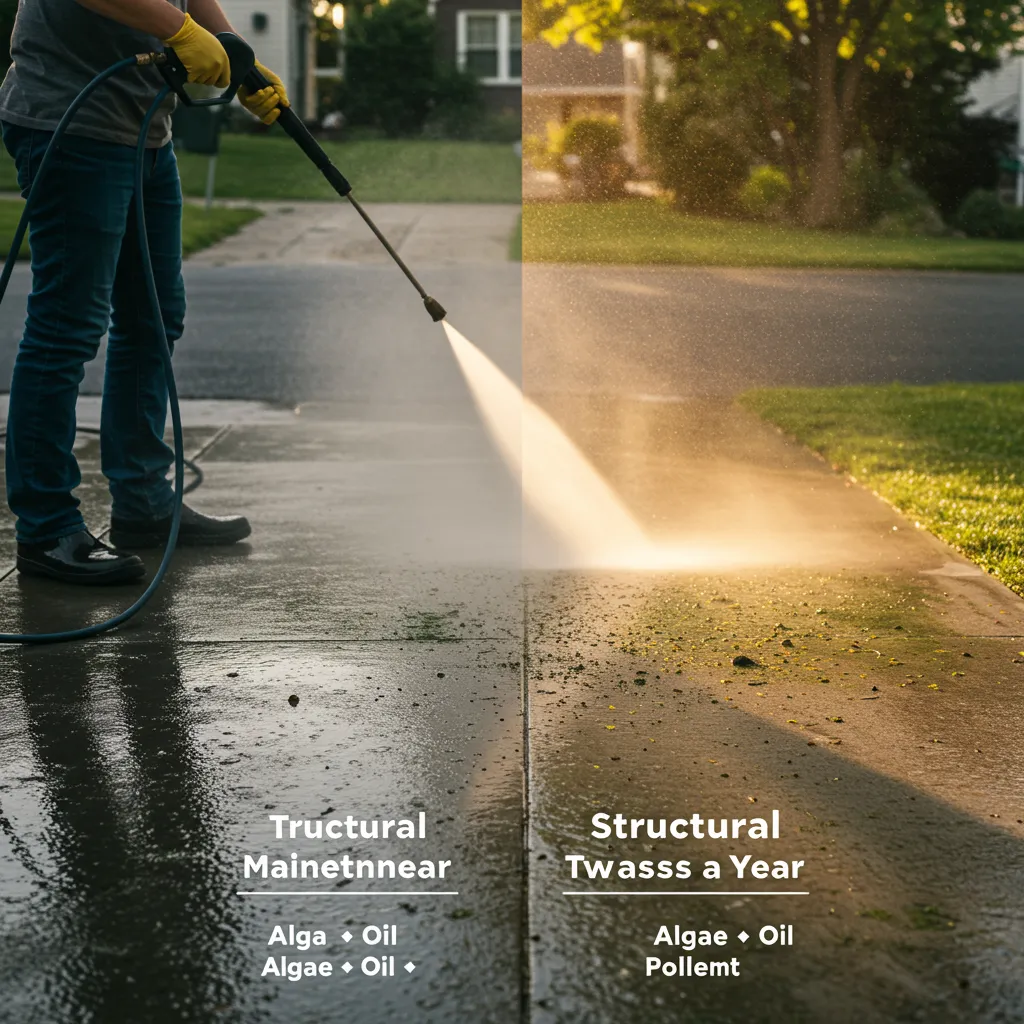
Why Your Driveway Needs a Maintenance Schedule, Not a Wash
Most homeowners think of pressure washing the driveway as a cosmetic job. Something you do before a party, or when company is coming, or when it finally gets bad enough to embarrass you. That framing is why most driveways in Oklahoma look the way they do — like they have not been properly maintained in years, because they have not been.
A driveway is not a decoration. It is a structural surface that takes thousands of pounds of weight every day, sits exposed to weather, absorbs anything that drips on it, and is the single largest exterior concrete asset most property owners have. It needs to be on a maintenance schedule the same way the roof needs to be on a maintenance schedule.
When it is not, the consequences are not cosmetic. They are structural and they are expensive.
What Goes Wrong When You Skip Maintenance
Concrete is porous. Every stain you can see on the surface — oil drips, mildew, algae, rust streaks, red clay tracking, pollen layered season after season — is partly on the surface and partly absorbed into the surface. Left in place, those contaminants continue to work down into the slab.
Oil is the worst offender. An oil drip left in place for a season does not stay where it landed. It migrates down through the pores of the concrete, weakening the structural matrix. The visible stain is a fraction of the actual damage.
Algae and mildew are next. They look like cosmetic problems but they are biological. They hold moisture against the surface, accelerating freeze-thaw damage every winter. In Oklahoma, where we get the freeze-thaw cycle multiple times per winter, algae left in place is one of the leading causes of premature surface spalling — the flaking and pitting that eventually requires concrete repair or replacement.
Pollen, seed pods, and organic debris compound the problem. They retain moisture, they decompose into mild acids, and they feed the next cycle of algae growth.
None of this damage shows up the year it starts. It shows up three to seven years later, when the slab starts to flake, crack, or develop low spots. By then the repair is no longer maintenance — it is replacement.
What a Real Maintenance Schedule Looks Like
A driveway on a proper maintenance schedule gets pressure washed twice a year. Once in late spring after the pollen drop and the first major storms, once in the fall after the leaves come down but before the freeze cycle starts.
The spring wash clears organic debris that would otherwise feed algae growth all summer. The fall wash clears organic debris that would otherwise trap moisture against the surface during the winter freeze-thaw cycle.
Two passes per year is enough to keep a concrete driveway in serviceable shape for decades longer than one that gets washed only when it gets visibly bad.
A driveway with heavy vehicle traffic, a wooded property with significant tree drop, or a property with regular oil drip issues may need a third pass mid-season. Most properties do fine with two.
What Pressure Washing Actually Does
A proper pressure wash is not a hose with extra pressure. The job uses specific equipment for specific reasons.
The pressure level has to be matched to the surface. Too high and you etch the concrete, creating new pores for future staining to embed in. Too low and you do not lift the embedded contaminants out. The right pressure for a residential driveway is in a specific range based on the concrete age and condition.
The detergent has to be matched to the stain type. Oil requires a different chemistry than algae. Rust requires a different chemistry than mildew. The wrong detergent leaves contaminants in place while making the surface look clean for a week.
The surface cleaner attachment matters. A wand-only pressure wash leaves stripes — visible streaks where each pass overlapped or did not overlap. A proper surface cleaner attachment provides even contact across the slab, which produces an even result.
The debris has to be removed. A finished job sweeps the lifted material off the slab and away from the property. Otherwise the contaminants you just removed wash right back onto the driveway during the next rain.
When to Schedule the First Pass
If your driveway has not been pressure washed since last fall, this is the month to handle it. May is the right window — the spring pollen has dropped, the early storms have done their work, and summer storm season is still ahead. Catching it now resets the surface for the year and prevents the algae bloom that follows the first stretch of summer humidity.
Wait until July or August and you have already lost months of damage potential. Wait until fall and you are stacking spring debris on top of fall leaves.
How We Run the Job
Curb Elite Solutions pressure washes residential and commercial driveways across the OKC metro — fourteen cities including OKC, Edmond, Norman, Moore, Yukon, Mustang, Piedmont, Del City, Midwest City, Shawnee, Guthrie, El Reno, Noble, and Purcell.
Every job runs the same way. The right pressure for the surface so we lift contaminants without etching the concrete. The right detergent for the stain types present on the property. The proper surface cleaner attachment for even results. Debris removed and the slab swept clean when we are finished.
Recurring maintenance schedules available for property owners who want the driveway handled twice a year without having to think about it.
Every job we run helps fund prison ministry, homeless outreach, and meeting people where they are. Real work, done right, with a mission behind it.
Photo quotes by text at (405) 788-5396. Scheduling and general inquiries at (405) 353-4174 or [email protected].