Prevent Emergencies with Fall Exterior Walk-Through
Property Management, Exterior Maintenance, Oklahoma City
The Fall Exterior Walk-Through That Kills “Surprise” Emergencies
Nearly every emergency maintenance call was visible months earlier during a slow walk around the outside of the building. At Curb Elite Solutions LLC, we see it every year in the Oklahoma City Metro area: the “sudden” leak, the “unexpected” trip hazard, the “out-of-nowhere” fascia failure. None of them are actually surprises. They’re just problems nobody looked for in August.
Why Late Summer Beats October Every Single Time
You can do an exterior walk-through any time, but if you manage properties around Oklahoma City, late summer is prime time. By the time October rolls around, you’ve lost three big advantages: weather, vendor availability, and budget-cycle leverage. Here’s how each one works in your favor when you start early.
1. Weather: Long Days, Predictable Conditions
Late summer in Oklahoma is warm, dry more often than not, and the days are still long. That means:
You can see rooflines, siding, and concrete clearly without fighting early sunsets.
Crews can safely work on roofs, lifts, and ladders without cold, wet, or icy conditions.
Paints, sealants, and coatings actually cure the way they’re supposed to.
In October, the clock works against you. Weather gets jumpy, rain days stack up, and that “simple” repair sits half-finished because it’s too wet, too cold, or too dark to finish safely. Emergencies love that kind of schedule.
2. Vendor Availability: Beat the Fall Rush
By mid-fall, every property manager in town suddenly remembers gutters, caulking, and parking lots. Crews book up. Lead times stretch. You start hearing the phrase, “We can get to that in three weeks,” right when you need the work done in three days.
When you walk your properties in late summer and lock in work orders early, you’re not begging for time on an overbooked calendar. You’re scheduling on your terms. At Curb Elite Solutions LLC, we’d rather plan your work in August than squeeze you in around emergencies in October. You probably feel the same way.
3. Budget-Cycle Leverage: Use the Current Year to Protect the Next
Late summer sits in a sweet spot in most budget cycles: you still have time to use current-year funds and you have fresh data to build next year’s budget. That gives you options October doesn’t:
Push obvious safety and water-intrusion issues into this year’s spend before the “use it or lose it” deadline.
Flag larger capital items (like major concrete, repainting, or roof work) with real numbers for next year’s plan instead of guesses.
Show ownership that you’re not reacting to problems; you’re forecasting them.
By October, budgets are usually locked, and every “new” emergency becomes an awkward conversation instead of a planned line item.
The Fixed Order: Roofline Down to the Punch List
A good walk-through is not a random stroll. It’s a slow, deliberate route in a fixed order so you don’t miss anything and you can repeat it the same way every year. We recommend this top-down sequence for commercial properties and larger residential sites:
Starting at the roofline lets you spot water and structural issues before they hit interiors.
1. Roofline and Drainage
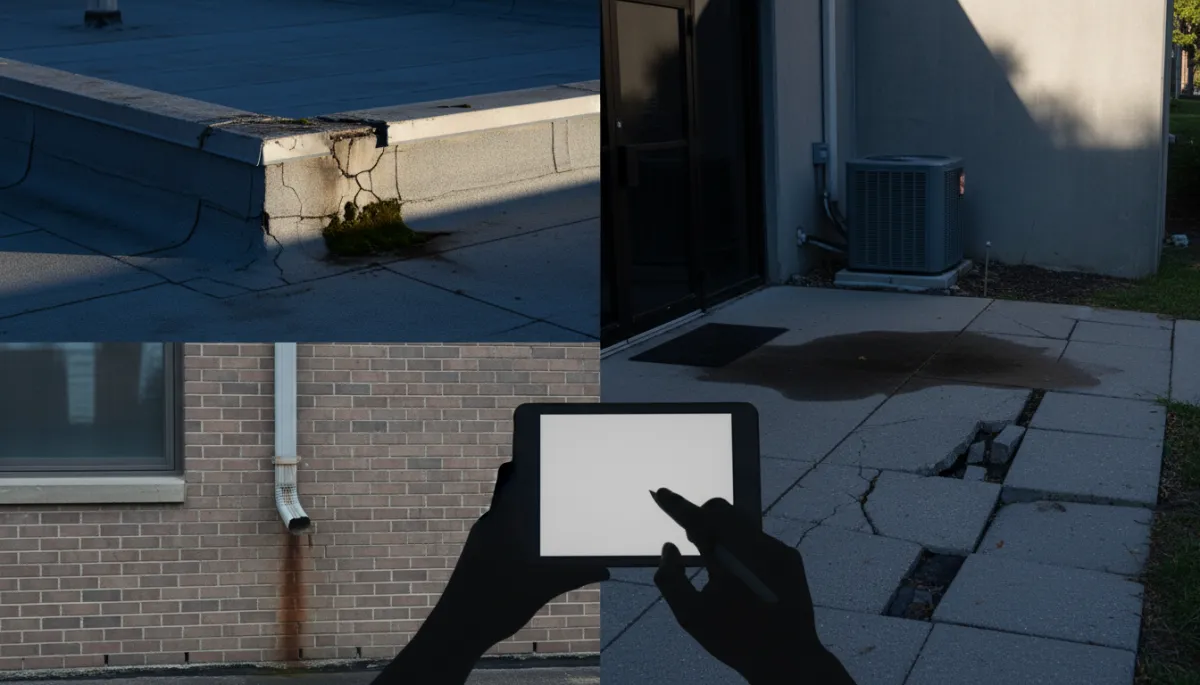
Roof edges and parapets: Look for sagging lines, loose flashing, missing shingles, ponding areas, and any signs of patchwork that’s failing.
Gutters and downspouts: Check for separation from fascia, rust, dents, clogs at outlets, and downspouts that dump water right at the foundation.
2. Walls, Siding, and Openings
Siding and masonry: Look for cracks, gaps, peeling paint, efflorescence, and areas where water clearly runs down the wall.
Windows and doors: Check caulking, seals, rusting frames, fogged glass, and damaged weatherstripping.
3. Entrances, Railings, and Stairs
Confirm handrails are solid, steps are even, and landings are free of spalling or heaving that can trip someone at 8 a.m. Monday.
Check thresholds and door sweeps for wear and gaps that let in water or pests.
4. Concrete, Asphalt, and Drainage Paths
Walk sidewalks, curbs, and parking lots. Note cracks, trip lips, low spots that hold water, and broken wheel stops or bollards.
Watch where water wants to go when it rains. If it heads toward doors, docks, or units, that’s a priority.
5. Landscaping, Fences, and Site Features
Look for tree limbs over roofs, bushes blocking sightlines or signage, and roots lifting concrete or pushing on foundations.
Check fences, gates, dumpsters, and enclosures for damage and loose hardware.
6. Lighting, Signage, and “Small” Punch-List Items
Note burned-out exterior lights, loose fixtures, damaged signs, and faded striping or ADA markings.
Capture all the little things that irritate tenants but never quite make it onto a work order—until they pile up and become a complaint.
💡 Pro Tip: Walk clockwise around each building every year. Same direction, same order, fewer missed issues.
Turn Every Finding into a Trend, Not a Surprise
A walk-through is only as good as the notes you keep. If your findings live on a legal pad that disappears into a truck, you’ll be “surprised” again next year. The goal is simple: document every issue so it becomes a year-over-year trend line, not a one-time fire drill.
Simple, consistent documentation turns scattered repairs into a predictable maintenance plan.
What to Capture for Each Item
Location: Building, side (north/south/east/west), and nearest door or unit number.
Issue type: Safety, water intrusion, aesthetics, or preventative maintenance.
Severity and timing: “Now,” “before winter,” or “next budget cycle.”
Photos: Wide shot for context, close-up for detail. Your future self will thank you.
Keep It the Same Every Year
Whether you use a spreadsheet, a maintenance app, or a shared folder, the key is consistency. Same fields, same order, same walk route. In year one, it’s just a list. In year two, you can compare. By year three, you can say things like:
“This crack has grown 40% in two years; time to schedule concrete work.”
“These gutters clog every fall on the west side; we need a cleaning schedule, not panic calls.”
Ownership likes data. Tenants like fewer surprises. Trends give you both.
One Vendor, One Scope, Less Chaos
After your walk-through, you’ll have a list that ranges from “replace three downspouts” to “repaint north façade” to “grind five trip lips.” The temptation is to farm each category out to a different specialist. That looks efficient on paper and feels organized—until you start living in the scheduling nightmare.
Bundling work with one reliable vendor cuts disruption and coordination time dramatically.
The Hidden Cost of “Shopping Around”
Multiple site visits for quotes mean more time walking the same ground with different people.
Tenants see crews in and out for weeks instead of a focused, short window of work.
You become the general contractor, juggling schedules, scopes, and warranties.
The price tag on each individual line item might look a hair lower when you slice it up, but the coordination hours and tenant disruption are where you quietly bleed.
Why Consolidating with One Vendor Wins
One mobilization: Crews, equipment, and materials show up once, not five times.
Coordinated phasing: Work can be grouped by area so tenants only deal with disruption in short bursts.
Clear accountability: When something’s missed, there’s no finger-pointing—just one call to get it corrected.
At Curb Elite Solutions LLC, our whole business model is built around this: one call for most exterior and basic-maintenance needs. We’d rather take the whole scope, plan it properly, and be the single throat to choke if something slips. You get fewer headaches, your tenants get fewer interruptions, and your buildings stay out of the emergency lane.
Make This Year the Last Year of “Surprise” Emergencies
Emergencies will still happen. Oklahoma weather and aging buildings guarantee that. But most of what shows up as an “emergency” on your phone in January was already visible in August if someone had taken a slow walk and written it down.
If you’re a homeowner, landlord, or property manager in the Oklahoma City Metro area, your playbook is straightforward:
Do a late-summer exterior walk-through, not a last-minute fall scramble.
Follow a fixed top-down order so nothing gets missed.
Document findings the same way every year so you see trends, not just problems.
Consolidate the resulting scope with one reliable vendor instead of playing air-traffic controller with five.
A clean, safe exterior is the quiet sign that someone is paying attention year-round.
Our promise at Curb Elite Solutions LLC is simple: we answer, we show up on the day we said, and we finish what we started. If you’d rather spend this winter managing your properties instead of chasing leaks and trip hazards, we can help you build that late-summer routine and knock out the resulting punch list before the weather turns.
📌 Ready to see what you’ve been missing? Schedule a slow, detailed exterior walk with someone who does this every day. Curb Elite Solutions LLC offers a straightforward, no-drama review of your property’s exterior conditions.
Get a Free Property Assessment with Curb Elite Solutions LLC, and let’s turn “surprise” emergencies into planned, boring, on-time maintenance—right where they belong.